Sich im Kreis zu drehen ist noch kein Beweis für Bewegung.
Ich versuche seit Jahren herauszufinden, was ein Bild heute noch sein kann. Ich habe die Antwort nicht. Man kann sie sich auch nicht am Tisch ausdenken. Man kann sie nur malen und schauen, was passiert. Der Grund dafür hat weniger mit Kunst zu tun, als man denkt.
Der Antrieb war von Anfang an derselbe. Ich wollte Bewusstsein erweitern. Das klingt groß, ist aber einfach gemeint: mehr sehen, als man gewohnt ist zu sehen.
Wir gehen alle davon aus, dass Sehen ein Empfangen ist. Draußen ist die Welt, drinnen ist ein Bild davon, und das Bild stimmt ungefähr. Diese Annahme sagt niemand laut. Sie sieht auch nicht aus wie eine Annahme. Sie sieht aus wie der Boden, auf dem man steht.
Sie ist kein Boden. Das kann jeder an sich selbst prüfen, nüchtern, in einer Minute.
In jedem Auge gibt es eine Stelle ohne Sinneszellen. Dort ist ein Loch in deinem Blickfeld. Du hast es nie gesehen, weil es nicht schwarz ist. Es wird gefüllt. Nicht bemerkt: erzeugt.
Farbe ist auch nicht draußen. Draußen sind Wellen, und die haben keine Farbe. Rot entsteht erst in dir.
Und wenn zwei gleich lange Linien so angeordnet sind, dass eine länger aussieht, kannst du nachmessen, so oft du willst. Du siehst sie weiter verschieden. Das Wissen kommt beim Sehen nicht an.
Jede Nacht baust du außerdem eine ganze Welt. Mit Raum, mit Gewicht, mit anderen Menschen. Im Traum ist alles vollkommen überzeugend. Und nichts davon war da.
Der Grund dafür ist einfach. Wahrnehmung ist nicht darauf gebaut, richtig zu sein. Sie ist darauf gebaut, zu funktionieren. Wer schnell genug reagiert, überlebt. Wer wartet, bis das Bild vollständig ist, nicht. Richtig und brauchbar fallen dabei auseinander.
Was wir Wirklichkeit nennen, ist also eine Arbeitsfläche. Sie bringt uns gut durch den Tag. Sie garantiert nicht, dass wir die Sache selbst sehen. Ein anderes Wort dafür ist Schnittstelle: die Stelle, an der zwei Dinge sich berühren, die einander nicht kennen müssen.
Wenn das stimmt, dann sind viele Regeln, die wir für Regeln der Wirklichkeit halten, Regeln der Oberfläche. Loslassen heißt nicht, dass nichts mehr wahr ist. Es heißt: aufhören, die Oberfläche für den Boden zu halten.
Das fühlt sich an wie verlieren. Nach jedem Schritt fehlt etwas, das eben noch Halt gegeben hat. Aber was da wegfällt, war nie Besitz. Es war eine Gewohnheit.
Ob am Grund von allem eine Einheit steht, weiß ich nicht. Das kann niemand entscheiden. Sicher ist nur, dass die Trennung, von der wir ausgehen, keine Tatsache ist. Sie gehört zur Oberfläche. Deshalb ist das, was man zu verlieren fürchtet, dasselbe, was am Ende des Loslassens steht. Es kommt nicht später. Es war die ganze Zeit da.
Sagen kann ich das alles nicht. Sprache beschreibt, und jede Beschreibung schiebt einen Inhalt davor. Ein Argument überzeugt, ändert aber nichts. Siehe die zwei Linien.
Manche Menschen wissen das nicht aus Büchern. Sie hatten Zustände, in denen die Oberfläche kurz nicht gehalten hat. In Narkose, in tiefer Ruhe, an einem Wendepunkt, manche im Rausch. Sie kommen nicht mit einem Beweis zurück, sondern erschüttert. Und dann erzählen sie, was sie gesehen haben. Genau das klingt unglaubwürdig, und zwar zu Recht, denn der Inhalt beweist nichts. Worum es ging, war nicht der Inhalt. Es war, dass die Oberfläche für einen Moment als Oberfläche sichtbar war. Davon lässt sich nicht erzählen. Deshalb landen solche Berichte bei den Anekdoten, und der Gedanke landet mit ihnen dort.
Ein Bild kann etwas anderes. Es beschreibt nicht. Es stellt ein Sehen hin, und das Sehen passiert dann an dir selbst.
Deshalb lasse ich drei Dinge weg.
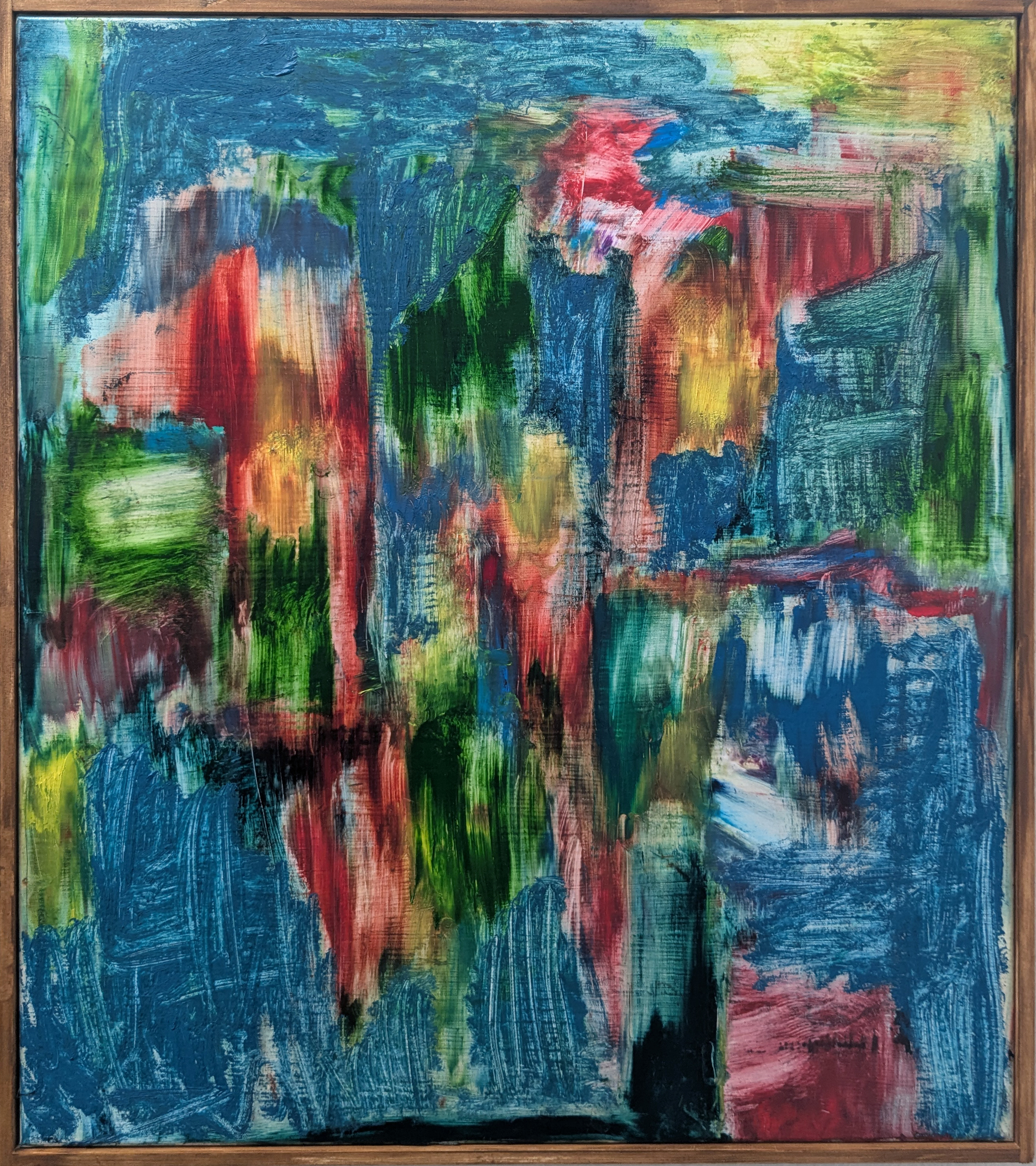
Ich male keine Figuren, keine Wesen, nichts, was man benennen kann. Sobald ein Ding im Bild ist, springt das Erkennen an. Dann sieht man nicht mehr, dann erkennt man nur noch. Die Fläche muss leer bleiben, damit das Sehen selbst sichtbar wird.
Ich male keinen Horizont. Damit gibt es keinen Standpunkt. Die Räume lassen sich nicht auflösen. Wer versucht, sie zu lesen, bekommt eine Tiefe, die der nächste Blick wieder umwirft. Das Auge bekommt alle Signale für Raum. Nur die Auflösung bekommt es nicht. Ein Raum, der funktioniert, ohne zu existieren.
Und ich male kein Licht, das von außen kommt. Das Licht kommt aus dem Bild. Farbe ohne Vorbild, Leuchten ohne Quelle. Nichts zeigt mehr nach draußen, weil es im Bild kein Draußen gibt.
Was übrig bleibt, ist eine Spur. Meine Bilder zeigen nicht, was da ist. Sie zeigen, dass etwas durchgegangen ist. Das, was sie festhalten, hat das Bild längst verlassen.
Beim Malen bin ich der Beobachter. Solange ich davorstehe, entscheidet sich alles an mir. Was bleibt, was verschwindet, wann es genug ist. In diesem Moment legt sich das Bild fest.
Dann höre ich auf und gehe weg.
Später steht jemand anderes davor, und ich bin nicht mehr da. Der Beobachter, an dem sich das Bild festgelegt hat, fehlt. Und damit ist das Bild wieder offen.
Ich denke dabei an das Doppelspaltexperiment. Man schickt einzelne Teilchen auf eine Wand mit zwei Spalten. Misst niemand, durch welchen Spalt sie gehen, entsteht dahinter ein Streifenmuster, als wäre jedes Teilchen durch beide gegangen. Misst man nach, verschwindet das Muster. Dann verhält sich jedes Teilchen wie ein Ding, das einen Weg genommen hat.
Physiker meinen mit Beobachter jede Messung und nicht ein Bewusstsein, das weiß ich. Ich nehme es als Bild und nicht als Beweis. Aber das Bild trifft, was ich meine. Solange gemessen wird, legt sich etwas fest. Fehlt die Messung, bleiben mehrere Möglichkeiten offen.
Ein fertiges Bild ist deshalb keine Nachricht von mir an dich. Es ist eine Stelle, die sich jedes Mal neu öffnet, wenn jemand davorsteht.
Ich weiß, wie meine Bilder von außen aussehen. Starke Farbe, sichtbare Geste, kein Gegenstand, Leuchtkraft. Dafür gibt es ein volles Regal der Kategorien. Es heißt psychedelisch, kosmisch, visionär, Science-Fiction, manchmal digital. Weiter hinten stehen die kunsthistorischen Fächer: lyrische Abstraktion, gestische Abstraktion, Farbfeldmalerei, Neo-Expressionismus, Neue Wilde, Op-Art, das Erhabene, Romantik, Zombie Formalism, Post-Internet. Für alles gibt es ein Fach. Das Einsortieren braucht kein Hinsehen, nur Merkmale, und nach zwei Sekunden ist es fertig.
Das ärgert mich nicht, es ist nur aufschlussreich. Auch dieser Blick ist auf Brauchbarkeit gebaut und nicht auf Wahrheit. Er will schnell eine Schublade öffnen und eine Sicherheit verstauen, um nicht die Orientierung zu verlieren. Sehen, was der Fall ist, dauert länger. Er macht also genau das, wovon der ganze Text handelt.
Und er verwechselt dabei Vokabular mit Grammatik. Diese Malerei benutzt einige Wörter dieser Ecke und keinen einzigen ihrer Sätze. Dort werden Zustände bebildert. Dort gibt es ein Jenseits, von dem berichtet wird, und die Farbe beschreibt ein Erlebnis. Bei mir gibt es nichts zu berichten. Kein Erlebnis, kein Jenseits, keine Botschaft. Was wie ein gesteigertes Sehen aussieht, ist ein Sehen ohne Gegenstand.
Ich schaue nicht nur auf Bilder. Die Rechte wird stärker, in fast jedem Land, und ich sehe dort vor allem Menschen, die sich vor Veränderungen fürchten, die sie nicht kontrollieren können. Das Klima kippt, und wir behandeln das wie eine Meinungsfrage. Eine Wirtschaft, die nur wachsen kann, frisst die Grundlagen auf, von denen sie lebt. Und es wird ununterbrochen Krieg geführt.
Ich habe dafür keine Erklärung. Ich traue auch keiner, die mir angeboten wird. Aber ich erkenne in all dem eine Bewegung wieder, die ich vom Malen kenne.
Wer eine Ordnung für die Wirklichkeit hält, muss sie verteidigen. Jede Änderung ist dann ein Angriff. Und wer sich angegriffen fühlt, wird hart. So fängt das meiste an, was Menschen einander antun. Nicht mit Bosheit. Mit Angst vor Verlust, und meistens mit der Angst, eine Gewohnheit aufgeben zu müssen, die Sicherheit gegeben hat.
Das gehört keiner Seite. Es passiert überall da, wo jemand meint, den Boden zu kennen. Auch bei denen, die sich für die Guten halten. Auch bei mir.
Beim Klima kommt etwas dazu, das unmittelbar mit dem Sehen zu tun hat. Unsere Wahrnehmung ist auf das gebaut, was nah ist, schnell und mit Gesicht. Eine Gefahr, die langsam ist, verteilt und ohne Gesicht, kommt bei diesem Apparat gar nicht erst an. Wir leugnen sie nicht nur. Wir sehen sie schlicht nicht. Das ist kein Charakterfehler, das ist die Bauweise. Ausgleichen kann man sie nur, wenn man weiß, dass man sie hat.
Und eine Wirtschaft, die von Aufmerksamkeit lebt, ist kein Zufall. Sie hat verstanden, wie dieser Apparat arbeitet, und zielt genau auf seine schwächste Stelle. Sie ist der bisher genaueste Beleg dafür, dass Wahrnehmung auf Brauchbarkeit gebaut ist und nicht auf Wahrheit. Nur benutzt sie das gegen uns.
Ich schreibe das in einer Zeit, in der Maschinen Bilder machen. Man tippt einen Satz ein und bekommt eine Ansicht, die nie jemand gesehen hat, von etwas, das es nicht gibt. Sie überzeugt sofort. Man nennt es künstliche Intelligenz.
Für die Malerei ist das keine Bedrohung. Es ist eher eine Bestätigung.
Diese Systeme sind Apparate, die aus Wahrscheinlichkeiten eine Welt bauen. Sie arbeiten hervorragend, ohne die Sache selbst zu kennen. Genau das behaupte ich über unsere Wahrnehmung. Wir haben uns jetzt eine zweite gebaut, außerhalb von uns, und können ihr beim Arbeiten zusehen.
Dabei geht etwas verloren, das lange selbstverständlich war. Ein Bild war ein Beweis. Wenn ein Foto etwas zeigte, dann war es da. Das gilt nicht mehr. Sehen und Glauben fallen jetzt öffentlich auseinander und nicht mehr nur in der Philosophie.
Deshalb glaube ich, dass wir in einem Übergang stecken. Übergänge fühlen sich so an, wie sie sich anfühlen, weil die Oberfläche aufhört zu tragen. Was gestern selbstverständlich war, trägt heute nicht mehr, und niemand weiß, was an die Stelle tritt. Das ist anstrengend, und es fordert uns mehr, als wir gewohnt sind.
In solchen Zeiten gibt es zwei Bewegungen. Die eine greift fester zu. Sie sucht eine Ordnung, die wieder wie ein Boden aussieht, und verteidigt sie. Das ist gerade die lautere von beiden.
Die andere schaut nach, was eigentlich hindert. Das ist die unangenehmere, denn das Hindernis liegt nie draußen. Es liegt in dem, woran man sich hält. Und das anzusehen ist fast immer das Schwerste, was im Moment zur Verfügung steht. Nicht weil es weh tut, sondern weil man dabei kurz keinen Boden hat.
Ich glaube, dass wir da gemeinsam durchmüssen und dass es keine Abkürzung gibt.
Ein Gemälde kann das nicht und will es nicht. Es ist eine Fläche, die auf nichts hin gerechnet ist, weil niemand sie ansehen muss. Malerei ist heute nicht wichtig, weil sie mehr zeigt als ein Bildschirm. Sie ist wichtig, weil sie weniger will.
Ich weiß, wie das klingt, wenn ein Maler so etwas schreibt. Ein Bild beendet keinen Krieg. Es senkt keine Emissionen. Es überzeugt niemanden, der nicht überzeugt werden will. Das ist mir klar, und ich will es nicht größer machen, als es ist.
Was ich anbieten kann, ist kleiner. Vielleicht ist es trotzdem nicht wenig.
Alles, was ich bis hier beschrieben habe, läuft auf eine einzige Fähigkeit hinaus. Sein Bild revidieren können, ohne sich dabei selbst zu verlieren. Das ist im Kern eine politische Fähigkeit. Eine Gesellschaft, die das nicht kann, wird hart. Ein Mensch, der das nicht kann, auch.
Und diese Fähigkeit lässt sich üben. Nicht mit Argumenten, die ändern nichts, siehe die zwei Linien. Sondern indem man sich in Lagen bringt, in denen die eigene Wahrnehmung sich vor einem selbst korrigiert und man merkt, dass man es überlebt.
Ein Bild ist so eine Lage. Es kostet nichts. Es verlangt nichts. Man steht davor, der Raum kippt, das Erkennen findet keinen Halt, und es geht einem gut dabei. Das ist die Übung. Erst dort, wo sie billig ist. Dann vielleicht an den Stellen, wo sie teuer ist.
Ich glaube nicht, dass Zeit nur eine Richtung hat. Wenn auch die Reihenfolge zur Oberfläche gehört, dann sind später und jetzt nicht so getrennt, wie es sich anfühlt.
Für meine Arbeit heißt das nicht, dass sie ihrer Zeit voraus ist. Das wäre ein Trost auf Rechnung der Zukunft, und darauf ist kein Verlass. Es heißt etwas Einfacheres. Meine Bilder sind ihrer Zeit gleichzeitig. Es passiert jetzt oder gar nicht. Hier, vor dem Bild, in den paar Minuten, die jemand davorsteht.
Das ist der Unterschied zwischen einer Ankündigung und einem Vollzug. Eine Ankündigung verweist auf eine Zukunft, in der sie eingelöst wird. Ein Vollzug findet statt oder nicht.
Ich behaupte nicht, dass mir das gelingt. Ich habe auch nicht den Anspruch, es zu schaffen. Ich glaube nur, dass der Versuch selbst schon die Sache ist. Man kann das nicht erreichen wollen und dann haben. Man kann es nur tun.
Und deshalb hält Malerei. Nicht, weil sie außerhalb der Zeit steht. Da steht nichts. Sondern weil es sich wiederholen lässt. Ein Bild läuft nicht ab. Es wartet. Und jedes Mal, wenn jemand davorsteht, passiert es wieder.
Zeitlos heißt nicht: außerhalb der Zeit. Zeitlos heißt: jederzeit.
Eines kann ich nicht beweisen, und darauf vertraue ich trotzdem. Das Loslassen der Sicherheit ist die eigentliche Antwort auf die Angst und nicht ihr Gegenteil. Eine Sicherheit, die verteidigt werden muss, macht immer neue Angst. Wer loslässt, verliert nichts, was er wirklich hatte. Meine Bilder haben keine Botschaft. Botschafter dafür wären sie gern.
Going in circles is not yet proof of movement.
For years I have been trying to find out what a painting can still be today. I don't have the answer. You can't think it up at a desk either. You can only paint it and watch what happens. The reason for that has less to do with art than you would think.
The drive was the same from the start. I wanted to widen consciousness. That sounds large, but it is meant simply: to see more than one is used to seeing.
We all assume that seeing is receiving. Out there is the world, in here is a picture of it, and the picture is roughly right. Nobody says this assumption out loud. It doesn't look like an assumption either. It looks like the ground you stand on.
It is not ground. Anyone can test this on themselves, sober, in a minute.
In every eye there is a place without sensory cells. There is a hole in your field of vision. You have never seen it, because it isn't black. It gets filled in. Not overlooked: produced.
Colour isn't out there either. Out there are waves, and they have no colour. Red only comes into being in you.
And if two lines of equal length are arranged so that one looks longer, you can measure them as often as you like. You will go on seeing them as different. The knowledge never arrives at the seeing.
Every night you also build an entire world. With space, with weight, with other people. In a dream everything is completely convincing. And none of it was there.
The reason is simple. Perception is not built to be right. It is built to work. Whoever reacts fast enough survives. Whoever waits until the picture is complete does not. Right and useful come apart in the process.
So what we call reality is a working surface. It gets us through the day well. It gives no guarantee that we are seeing the thing itself. Another word for it is interface: the place where two things touch that don't have to know each other.
If that is true, then many rules we take for rules of reality are rules of the surface. Letting go does not mean that nothing is true any more. It means: to stop taking the surface for the ground.
It feels like losing. After every step something is missing that gave you a hold a moment ago. But what falls away was never property. It was a habit.
Whether there is a unity at the bottom of everything, I don't know. Nobody can decide that. The only certainty is that the separation we start from is not a fact. It belongs to the surface. Which is why what you are afraid of losing is the same thing that stands at the end of letting go. It doesn't arrive later. It was there the whole time.
I can't say any of this. Language describes, and every description pushes a content in front of it. An argument convinces but changes nothing. See the two lines.
Some people know this not from books. They have had states in which the surface briefly failed to hold. Under anaesthesia, in deep quiet, at a turning point, some in intoxication. They don't come back with a proof, they come back shaken. And then they tell you what they saw. That is exactly what sounds implausible, and rightly so, because the content proves nothing. What mattered was not the content. What mattered was that the surface was briefly visible as a surface. That can't be told. So such reports end up filed under anecdote, and the thought ends up there with them.
A painting can do something else. It doesn't describe. It puts a seeing in front of you, and then the seeing happens on you.
That is why I leave three things out.
I paint no figures, no beings, nothing that can be named. The moment a thing is in the picture, recognition kicks in. Then you no longer see, you only identify. The surface has to stay empty so that seeing itself becomes visible.
I paint no horizon. That leaves no standpoint. The spaces cannot be resolved. Anyone who tries to read them gets a depth that the next glance overturns again. The eye receives every signal for space. Only the resolution it does not receive. A space that works without existing.
And I paint no light that comes from outside. The light comes out of the picture. Colour without a model, glow without a source. Nothing points outwards any more, because inside the picture there is no outside.
What remains is a trace. My paintings do not show what is there. They show that something has passed through. Whatever they hold has long since left the picture.
While painting, I am the observer. As long as I am standing there, everything is decided on me. What stays, what disappears, when it is enough. In that moment the painting settles.
Then I stop and walk away.
Later someone else stands in front of it, and I am no longer there. The observer on whom the painting settled is missing. And with that the painting is open again.
I think here of the double-slit experiment. Single particles are sent at a wall with two slits. If nobody measures which slit they go through, a striped pattern appears behind it, as though every particle had gone through both. If you do measure, the pattern disappears. Then each particle behaves like a thing that took one path.
By observer, physicists mean any measurement and not a consciousness, I know that. I take it as an image and not as proof. But the image is exact about what I mean. As long as measurement happens, something settles. Without the measurement, several possibilities stay open.
A finished painting is therefore not a message from me to you. It is a place that opens anew each time someone stands in front of it.
I know how my paintings look from outside. Strong colour, visible gesture, no object, luminosity. There is a full shelf of categories for that. It is called psychedelic, cosmic, visionary, science fiction, sometimes digital. Further back stand the art-historical compartments: lyrical abstraction, gestural abstraction, colour field painting, neo-expressionism, Neue Wilde, op art, the sublime, romanticism, zombie formalism, post-internet. There is a compartment for everything. The sorting needs no looking, only features, and after two seconds it is done.
This doesn't annoy me, it is simply instructive. That gaze too is built for usefulness and not for truth. It wants to open a drawer quickly and stow a certainty away, so as not to lose its bearings. Seeing what is the case takes longer. So it does precisely what this whole text is about.
And in doing so it mistakes vocabulary for grammar. This painting uses a few words from that corner and not a single one of its sentences. Over there, states are illustrated. Over there is a beyond that gets reported on, and the colour describes an experience. With me there is nothing to report. No experience, no beyond, no message. What looks like a heightened seeing is a seeing without an object.
I don't only look at pictures. The right is growing stronger, in almost every country, and what I mainly see there are people afraid of changes they cannot control. The climate is tipping, and we treat that as a matter of opinion. An economy that can only grow is eating up the foundations it lives on. And war is being waged without interruption.
I have no explanation for this. Nor do I trust any that is offered to me. But I recognise in all of it a movement I know from painting.
Whoever takes an order for reality has to defend it. Every change is then an attack. And whoever feels attacked becomes hard. That is how most of what people do to each other begins. Not with malice. With fear of loss, and mostly with the fear of having to give up a habit that gave security.
This belongs to no side. It happens everywhere someone believes they know the ground. Among those who take themselves for the good ones as well. With me as well.
With the climate something else comes in that has to do directly with seeing. Our perception is built for what is close, fast and has a face. A danger that is slow, distributed and faceless never even arrives at this apparatus. We don't only deny it. We simply don't see it. That is not a character flaw, that is the construction. You can only compensate for it if you know you have it.
And an economy that lives on attention is no accident. It has understood how this apparatus works, and it aims exactly at its weakest point. It is the most precise evidence so far that perception is built for usefulness and not for truth. Only it uses that against us.
I am writing this at a time when machines make pictures. You type in a sentence and get a view nobody has ever seen, of something that doesn't exist. It convinces immediately. People call it artificial intelligence.
For painting this is no threat. It is more like a confirmation.
These systems are apparatuses that build a world out of probabilities. They work superbly without knowing the thing itself. That is exactly what I claim about our perception. We have now built a second one, outside ourselves, and we can watch it at work.
In the process something is lost that was taken for granted for a long time. A picture used to be proof. If a photograph showed something, then it was there. That no longer holds. Seeing and believing are now coming apart in public and not only in philosophy.
That is why I think we are stuck in a transition. Transitions feel the way they feel because the surface stops holding. What was self-evident yesterday no longer holds today, and nobody knows what takes its place. That is exhausting, and it demands more of us than we are used to.
In such times there are two movements. The one grips tighter. It looks for an order that looks like ground again, and defends it. That is the louder of the two right now.
The other looks at what is actually in the way. That is the more uncomfortable one, because the obstacle is never outside. It lies in what you are holding on to. And looking at that is almost always the hardest thing available in the moment. Not because it hurts, but because for a moment you have no ground.
I think we have to get through this together and that there is no shortcut.
A painting can't do that and doesn't want to. It is a surface calculated for nothing, because nobody has to look at it. Painting matters today not because it shows more than a screen. It matters because it wants less.
I know how it sounds when a painter writes something like this. A painting ends no war. It lowers no emissions. It convinces nobody who doesn't want to be convinced. I am clear about that, and I don't want to make it bigger than it is.
What I can offer is smaller. Perhaps it is still not little.
Everything I have described up to here comes down to a single ability. To be able to revise your picture without losing yourself in the process. That is at bottom a political ability. A society that can't do it becomes hard. A person who can't do it does too.
And this ability can be practised. Not with arguments, they change nothing, see the two lines. But by putting yourself in situations where your own perception corrects itself in front of you and you notice that you survive it.
A painting is such a situation. It costs nothing. It demands nothing. You stand in front of it, the space tips, recognition finds no hold, and you are fine while it happens. That is the exercise. First where it is cheap. Then perhaps in the places where it is expensive.
I don't think time has only one direction. If the sequence too belongs to the surface, then later and now are not as separate as it feels.
For my work that doesn't mean it is ahead of its time. That would be a consolation charged to the future, and the future can't be relied on. It means something simpler. My paintings are contemporaneous with their time. It happens now or not at all. Here, in front of the painting, in the few minutes someone stands there.
That is the difference between an announcement and an enactment. An announcement points to a future in which it will be redeemed. An enactment takes place or it doesn't.
I don't claim that I succeed at this. Nor do I have any claim to pulling it off. I only believe that the attempt itself is already the thing. You can't want to achieve it and then have it. You can only do it.
And that is why painting holds. Not because it stands outside time. Nothing stands there. But because it can be repeated. A painting does not expire. It waits. And every time someone stands in front of it, it happens again.
Timeless does not mean: outside time. Timeless means: any time.
There is one thing I cannot prove, and I trust it all the same. Letting go of security is the real answer to fear and not its opposite. A security that has to be defended keeps producing new fear. Whoever lets go loses nothing they really had. My paintings have no message. Ambassadors for that they would gladly be.